Showing posts with label Imbalance. Show all posts

Monday, 31 May 2010

GDS Digital

GDS Digital is a company that specialises in making info graphics for websites and articles. Below is some of their work I believe is a good example of data visualisation.

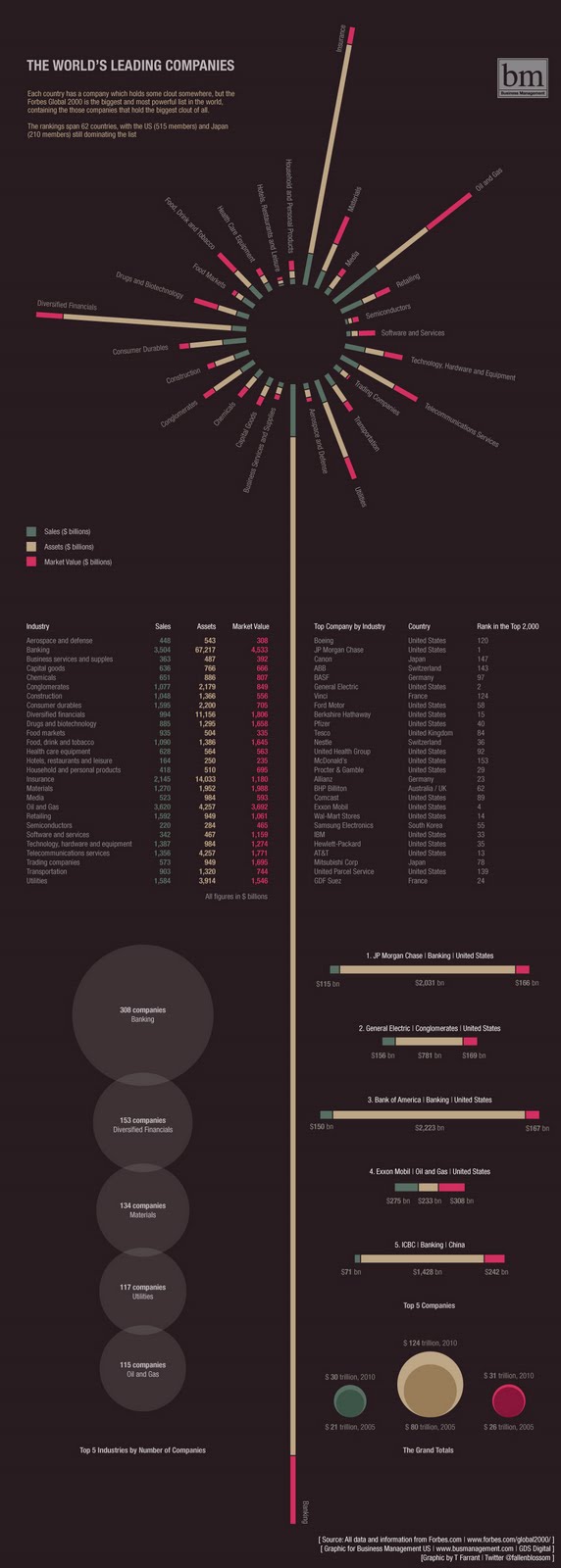
The World's Leading Companies


This graphic was created for Business Management and looks at the top companies in the world on the the Forbes Global 2000 list and breaks them down into industry and sectors, looking at how much money is made in which fields.


The large yellow line down the graphic isn't there as a margin between the 2 columns but actually part of  the diagram at the top for the banking sector, demonstrating the grip the financial sector has on the world. This can be seen online along with it's accompanying article on Business Week: http://www.busmanagement.com/news/the-worlds-leading-companies/

Gulf of Mexico Oil Spill


GDS Digital

GDS Digital is a company

The Evolution of Privacy on Facebook

For the Imbalance brief I have been looking at data graphics. Below are a set done by Matt McKeon, a developer working with the Visual Communication Lab at IBM Research. They document the how Facebook's privacy policies have changed over the years and how newer default settings grant access to different data sets on your profile:


A scary thought indeed to see how your data has spread through the years, however a nice example of data visulisation. Simple, effective, clean.

An interactive version of this can be seen on McKeon's website: http://mattmckeon.com/facebook-privacy/

Voting Turnout – Age & Gender

While researching election turnout, I came across a study by the University of Essex looking at voter turnout by age and gender. I thought it would be interesting to include to see if comparisons can be made between different variables of voting groups.


Voting Turnout Statistics


As one of my FMP briefs I have chosen to do ISTD's Imbalance brief from this year's award briefs. I have chosen to do this brief as it provides a good opportunity to work with a political theme within my work.

Following this year's General Election I have decided to look at voting turnouts and the idea of 'my vote doesn't count' attitude towards voting. As this is an ISTD brief it asks for a typographical interpretation of fact, so I want to also couple this with statistics to give me the opportunity to incorporate some information/data graphics into the project. I have started looking at turnout results for the UK general election to get me started with some figures to work with.

Here are turnout results for the UK General Election from 1918 to 2001.

(From the House of Commons Library Research Paper 04/61 - 'UK Election Statistics 1918-2004', page 17. Available from http://www.parliament.uk/documents/commons/lib/research/rp2004/rp04-061.pdf)

Below are turnout statistics since 1945, covering up to the 2005 election.


(From International IDEA (The International Institute for Democracy and Electoral Assistance). Available from: http://www.idea.int/vt/country_view.cfm?CountryCode=GB#parl)

A lot of the official documentation from these sites hasn't been updated to include this year's election but BBC is reporting 65.1% turnout. (Available from: http://news.bbc.co.uk/1/hi/uk_politics/election_2010/8672976.stm. I feel this number is safe to trust due to the Electoral Commission suggesting the BBC as a source while they verify results themselves: http://www.electoralcommission.org.uk/home)


I now have General Election turnout results from 1918 up until this year's 2010 election. The 1918 election was the first election after the The Representation of the People Act 1918 that widened the right to vote to virtually all men and women over 30 that met certain minimum property qualifications and so is seen as a milestone year from the political process in this country, however I will be concerning myself with the results from 1928 onwards where women's suffrage was brought inline with that of males,  enabling all citizens 21 and over to vote – a truer definition of electoral quality.
Sunday, 30 May 2010

Imbalance: Information Is Beautiful

I came across a book titled 'Information Is Beautiful' by David McCandless which is cover to cover full of infographics he has done. He has a really simplistic illustration style yet some of the graphics he does are quite complex or heavy. This marriage or simple graphics and heavy information seems to work well and I assume keeps the reader interested and engages with them about the topic.


Imbalance: Electoral Commission

The Electoral Commission is the body that oversees the election process in the UK. I have been using some of their statistics on information for my booklet.


Imbalance: Stats

More statistics for my Imbalance document I am putting together. These will help me create graphs to emphasise my point.


I have only included the cover here for clarity and left out any other pages that I am not using. just the statistics from the 2 above pages. The full document can be downloaded from their website: http://www.hansardsociety.org.uk

Imbalance: BBC Election Graphics

Here are the BBC's election infographics. They aren't quite as fancy as the Guardian's but they are still simple and I believe that's why they work. They get the message across – I will need to remember this when doing my infographics:


Imbalance: More Guardian Infographics


Imbalance: Guardian 2010 Election Graphics

For the Imbalance brief I will be looking at infographics. I would like to be creating something as clean as the Guardian's graphics for this year's election. Very crisp, simple and well designed.


See them in there interactive forms on Guardian's website here: http://www.guardian.co.uk/politics/interactive/2010/may/06/uk-election-results-map